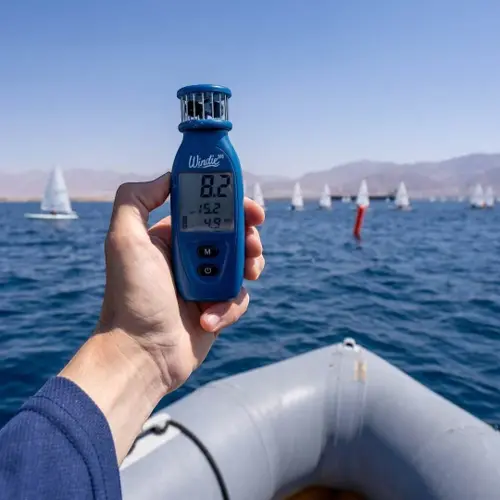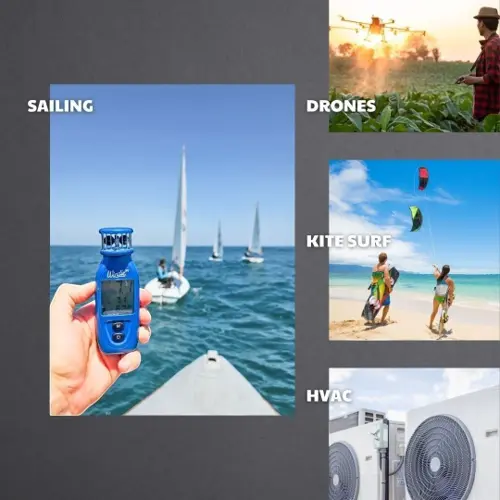
An anemometer is the basic wind tool for sailing, kitesurfing, windsurfing and every other wind sport. It tells you which sails to use, whether it is safe to go out, and, for race officers, whether a race can start at all.
We looked at the four designs you find in the affordable price range and compared them on what actually matters on a boat: accuracy when the wind shifts, one hand use, durability, batteries and reading speed.
The four common types of hand anemometer
Almost every affordable handheld wind meter belongs to one of four designs. They all measure wind speed, but they behave very differently on a boat.
1. Open propeller (vane) meters
A small propeller on the front of a slim body. They are cheap and common, but the propeller must face straight into the wind. Turn it 20 or 30 degrees off the wind and the reading drops. They often need a cap to protect the propeller in a bag.
2. Fold out or two part meters
The sensor folds out of a case or slides out of a sleeve before use. They protect the sensor well, but opening them usually takes two hands, which is not ideal when you are steering or holding on.
3. Smartphone plug in meters
A small rotor that plugs into the phone's headphone or charging port and uses an app. Light and cheap, but you need a phone out on deck, a matching port, and a working app.
4. 360 degree cup meters
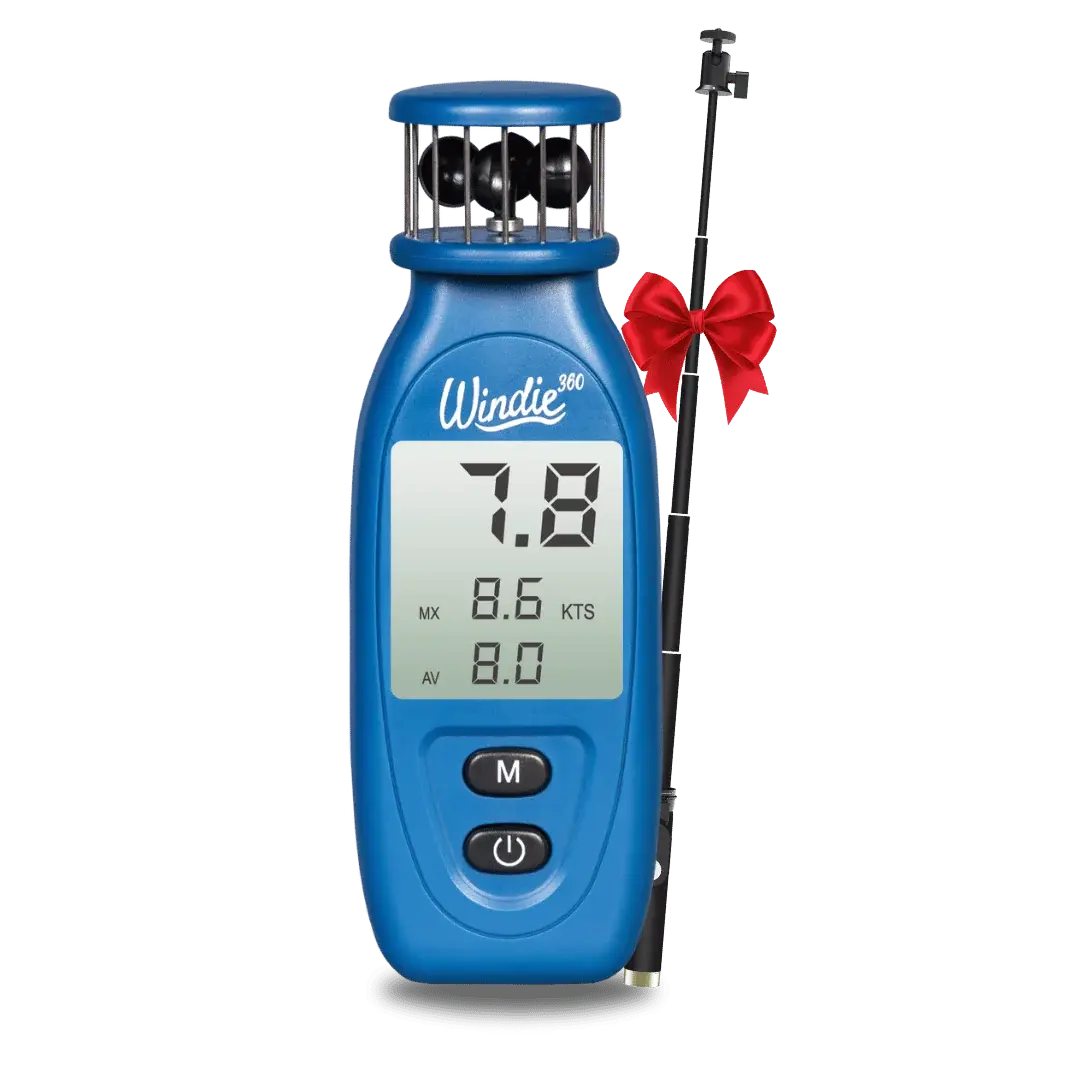
Cups spin on a rotor inside a protective cage. Because cups catch the wind from every side, the reading does not depend on where you point the meter. The Windie 360 is this type.
Side by side comparison
| What matters on the water | Windie 360 (cup) | Propeller | Fold out | Phone plug in |
|---|---|---|---|---|
| Reads correctly without aiming at the wind | Yes | No | Usually no | No |
| Ready with one hand | Yes | Mostly | No | No |
| Sensor protected without a cap | Yes, caged | No | Yes | No |
| Common batteries | AAA | Often coin cells | Varies | Phone battery |
| Replaceable sensor head | Yes | Rarely | Rarely | No |
| Works without a phone or app | Yes | Yes | Yes | No |
This is a comparison of typical designs, not of specific competitor models. Individual products vary.
The five things to check before you buy
1. Accuracy in a shifting breeze
On a moving boat the wind direction changes all the time. A meter that needs aiming will read low whenever you are a few degrees off, and you rarely know by how much. A 360 degree meter removes that error, which is why race officers prefer it for start and postponement decisions.
2. One hand use
On the water one hand is always busy: on the tiller, the radio, a flag or the rail. Choose a meter you can take out, read and put away with one hand. The Windie 360 is shaped to sit in the palm and has no lid to open.
3. Durability in a kit bag
Meters live in wet bags with shackles, horns and flags. Look for a sensor protected by a cage or a case. Check that the head can be replaced, so one knock does not mean buying a new meter.
4. Batteries you can find anywhere
AAA batteries are sold in almost every harbour shop in the world. Coin cells and special packs are harder to find on a regatta trip. The Windie 360 runs about 40 hours on a set of AAA batteries.
5. Reading speed
For gust decisions you want a new reading every second, with the highest gust easy to spot. Slow averaging meters hide the gusts that matter most for safety.
Our verdict
If you mostly measure from a still position on land and do not mind aiming, a propeller meter is a fair budget choice. If you measure from boats, need one hand free, or make decisions that others rely on, a 360 degree cup meter like the Windie 360 is the safer pick.
Looking for a full buyer's guide with specific models? Read the best handheld anemometer to buy in 2026 on windie.pro.
Not sure how the different types work? Read what an anemometer is first.