Two people on the same race area can read very different wind speeds and both be holding a good anemometer. The difference is almost always in how they measured, not the meter.
This guide explains the main reasons readings differ, and a simple routine that gives you numbers you can trust.
True wind and apparent wind
When a boat moves, the wind you feel is a mix of the real (true) wind and the wind made by your own speed. This is apparent wind. Sailing upwind, apparent wind is stronger than true wind; sailing downwind it is weaker. An anemometer on a moving boat measures apparent wind. For decisions about the course or safety, measure while stopped.
Height and shelter
Wind is slower close to the water because of friction. A reading at chest height on a low RIB can be noticeably lower than one at the top of a mast. Sails, people, cabins and the hull also create wind shadows. Hold the meter as high as you can, upwind of everything, or use a stick holder. Compare readings between boats only when they are taken the same way.
Aiming errors
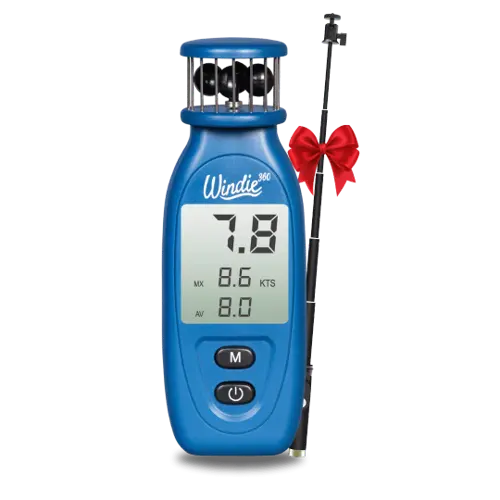
Propeller anemometers read correctly only when they face straight into the wind. On a boat that swings on its anchor, a few degrees off already lowers the reading. A 360 degree cup meter such as the Windie 360 avoids this, because its cups catch the wind from every side.
Averages and gusts
Wind is never steady. A single number can be a gust or a lull. Watch the meter for 20 to 30 seconds and note both the average and the highest gust. A meter that samples every second makes the gusts easy to see. For safety calls, the gusts often matter more than the average.
Units and the Beaufort scale
Sailors usually think in knots, weather apps often use km/h or m/s, and some forecasts use Beaufort. Mixing them up is a common mistake. Use our wind speed converter to switch units and see the Beaufort force at a glance.
A quick checklist
- Stop the boat, or note that you are reading apparent wind.
- Hold the meter high and upwind of people and sails.
- Read for 20 to 30 seconds. Write down average and top gust.
- Repeat in two or three places on the race area.
- Keep the same method all day, so readings stay comparable.