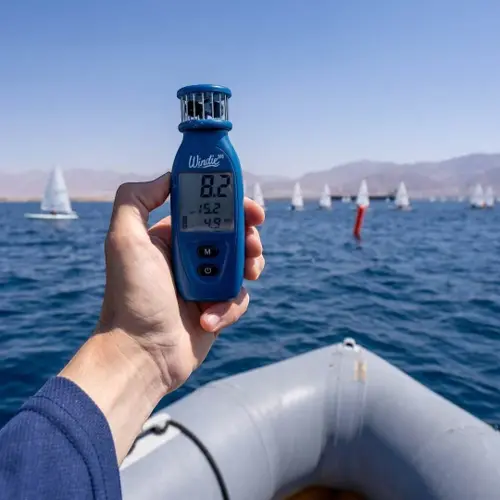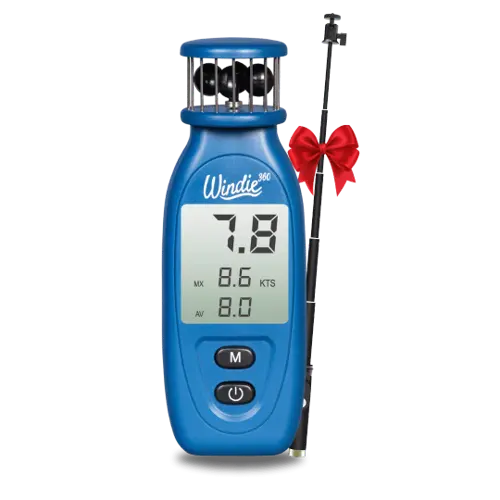
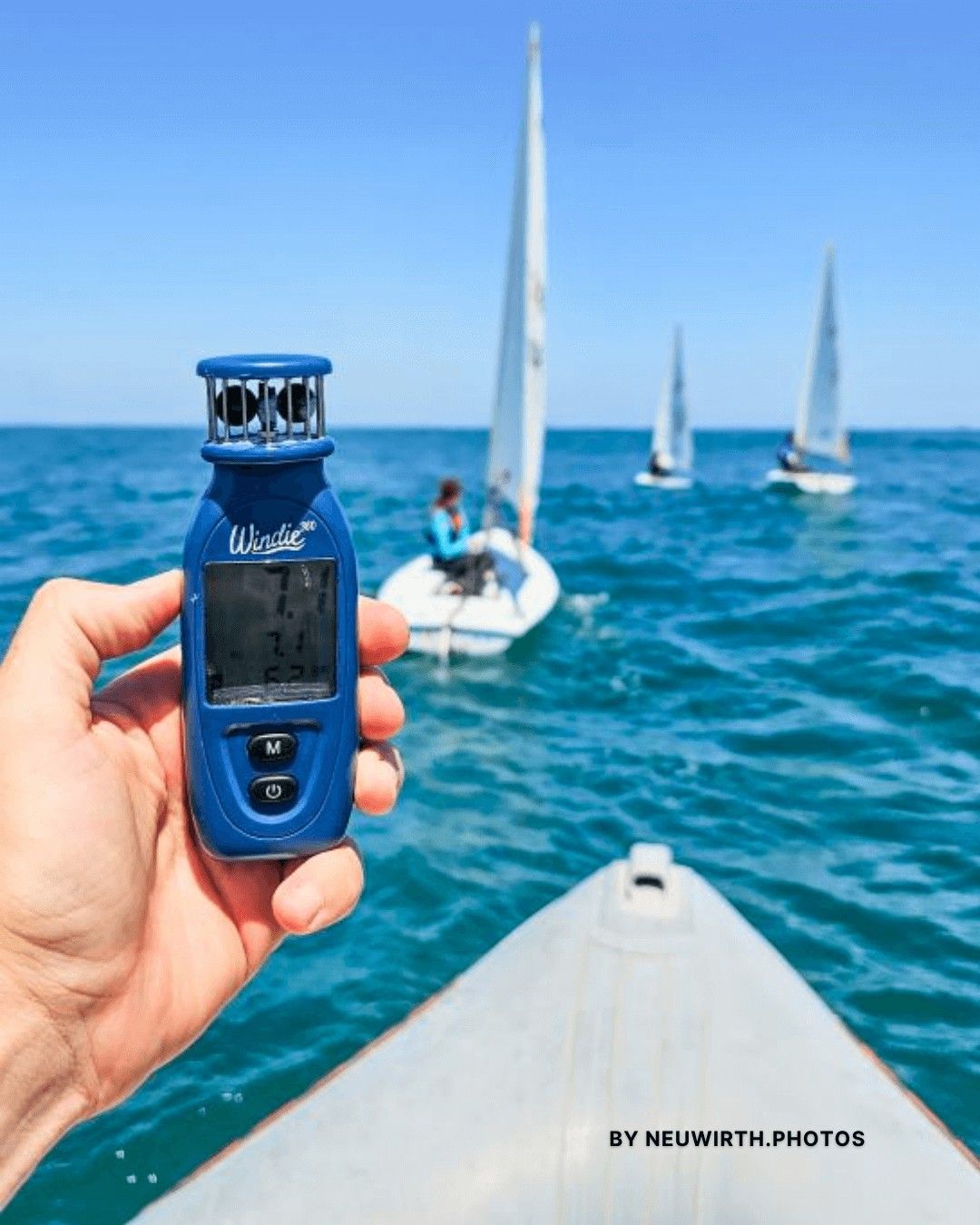
In short: An anemometer is an instrument that measures wind speed. The most common outdoor type is the cup anemometer, whose cups spin faster as the wind gets stronger and read the wind from any direction. Handheld anemometers show the speed where you stand, in knots, km/h, m/s or mph. An anemometer measures speed, not direction; a wind vane shows direction.
Every weather station has one, but the most useful anemometer is often the one in your pocket. Here is what it measures, the main types, and how to get a reading you can trust.
What an anemometer measures
An anemometer measures wind speed: how fast the air is moving past a point. The name comes from the Greek word anemos, wind. Most handheld models show the result in knots, km/h, m/s or mph, and many also show the strongest gust and an average over a short time.
An anemometer does not tell you where the wind comes from. That is the job of a wind vane, a wind sock, a flag, or a compass and your own eyes. Weather stations usually have both.
The main types of anemometer
| Type | How it works | Good for |
|---|---|---|
| Cup | Three or four cups on a rotor. The rotor spins faster as the wind gets stronger. | Weather stations, boats, beaches, handheld use. Reads wind from any direction. |
| Vane (propeller) | A small propeller turns in the wind. It reads correctly only when it faces straight into the wind. | Air flow from vents and ducts, and quick checks when you can aim it. |
| Hot wire | A heated wire cools faster in moving air. The electronics measure that cooling. | Very low air speeds indoors, HVAC ducts, research. |
| Ultrasonic | Sound pulses travel between sensors. Moving air changes their travel time. | Fixed weather and research stations. No moving parts, higher price. |
| Pitot tube | Compares the pressure of moving air with still air. | Aircraft airspeed and wind tunnels. |
How a cup anemometer works
The open side of each cup catches more wind than the round back, so the rotor always turns the same way, whatever direction the wind blows from. A sensor counts the turns and the screen converts them into wind speed.
The design is old. Leon Battista Alberti described a mechanical wind meter around 1450, and the Irish astronomer Thomas Romney Robinson built the cup anemometer in 1845 and 1846. Weather stations still use the same idea today.
A handheld version like the Windie 360 puts the cups inside a protective cage, so the meter can live in a pocket or a kit bag and still read the wind from any side.
Handheld vs fixed anemometers
A fixed anemometer on a mast or roof gives a continuous record from one spot. A handheld anemometer gives you a reading exactly where you stand, which is what you need to decide something now: on a boat, on a beach, at a launch site or on a work platform.
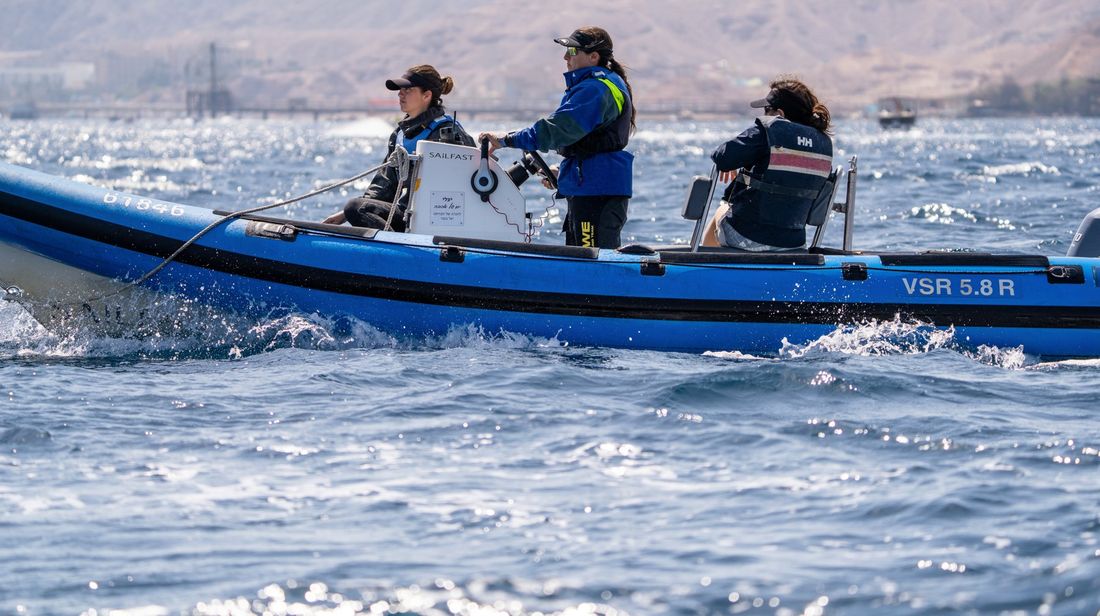
For a side by side look at handheld designs, see our hand anemometer comparison.
Who uses an anemometer
- Sailors and race officers: to start, postpone or shorten a race, and to set the course length. See anemometers in sailing regattas.
- Kitesurfers and wing foilers: to choose the kite or wing size. See the kite and wing size wind chart.
- Drone pilots: to check the wind against the drone's limit. See how much wind a drone can fly in.
- Paragliders, anglers, golfers, crane and scaffold crews, event organisers: see handheld anemometer uses.
How to read an anemometer correctly
- Hold it up at arm's length, away from your body, buildings, sails and trees.
- Give it 20 to 30 seconds. Wind is never steady, so note the average and the highest gust.
- Measure where it matters: at the launch spot, on the start line, at the height you will work.
- Measure from the same spot each time. Comparing today with yesterday is often more useful than the exact number.
- On a moving boat you measure apparent wind, which is your own speed plus the true wind. Stop to measure the true wind.
- Convert units if your spec sheet uses a different one. Our wind speed converter also shows the Beaufort force.
Common mistakes
- Measuring in the shelter. Next to a car, a wall or a dune the reading can be half of the real wind.
- Reading one number. A single glance can catch a lull or a gust. Watch for half a minute.
- Trusting the beach for the water. The wind a little way offshore can be a few knots stronger than on the sand.
- Aiming a vane meter badly. A propeller meter held a few degrees off the wind reads low. A cup meter avoids this.